
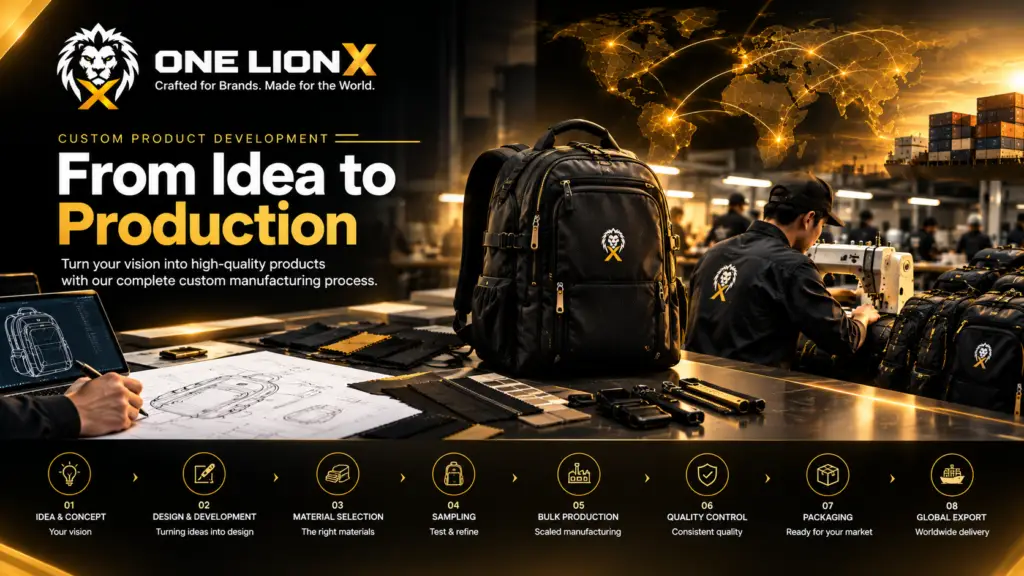
How to Develop a Custom Product From Idea to Production
Developing a custom product requires more than having a good idea. A successful product must be designed around its intended use, materials, construction, functionality, branding, target market, and production requirements.
For brands, wholesalers, distributors, and importers, working with an experienced custom product manufacturer can help turn an initial concept into a production-ready product.
The process can begin with something as simple as an idea, sketch, reference image, or existing product and progress through development, sampling, production, quality control, packaging, and export.
In this guide, we explain the key stages of the custom product development process.
What Is Custom Product Development?
Custom product development is the process of creating or modifying a product around specific requirements.
These requirements can include:
- Product design
- Dimensions
- Materials
- Colors
- Features
- Construction
- Functionality
- Branding
- Packaging
- Target market
- Production quantity
Instead of manufacturing only a standard product, the manufacturer works with the buyer to develop a product that fits the intended application and market.
For example, a brand may want a sports bag with a specific size, compartment arrangement, fabric, logo placement, padding, and packaging.
The manufacturer can work through these requirements to develop a product suitable for production.
Where Does Custom Product Development Start?
A custom product project does not necessarily require a finished technical drawing.
A project can begin with:
An Idea
You may only have an idea of what you want the final product to look like or how it should function.
A Sketch
A basic hand-drawn sketch can help communicate the initial concept.
A Reference Image
Existing product images can provide a visual starting point.
An Existing Product
A physical product can be used as a reference for dimensions, construction, materials, or functionality.
A Reference Sample
A sample can help define the required design and construction.
Technical Specifications
Detailed measurements, materials, features, and production requirements can provide a more structured starting point.
The amount of information available at the beginning affects the development process, but a project can evolve as requirements become clearer.
The Custom Product Development Process
A structured process helps move a product from concept to production.
01 — Define Your Product Requirements
The first step is to clearly define what you want to manufacture.
Important requirements may include:
- Product type
- Intended use
- Target customer
- Dimensions
- Capacity
- Materials
- Colors
- Features
- Branding
- Packaging
- Estimated order quantity
- Target market
The clearer the requirements, the easier it becomes to develop a practical manufacturing solution.
02 — Review the Design or Concept
Once the basic requirements are available, the product concept can be reviewed.
This stage may involve evaluating:
- Product shape
- Dimensions
- Construction
- Compartments
- Pockets
- Handles
- Straps
- Closures
- Padding
- Reinforcement
- Hardware
- Branding placement
The purpose is to understand how the concept can be translated into a manufacturable product.
03 — Select Suitable Materials
Material selection is an important part of custom product development.
Depending on the product, materials may include:
- Fabrics
- Synthetic materials
- Mesh
- Webbing
- Padding
- Lining
- Zippers
- Buckles
- Hardware
- Other components
The right materials depend on factors such as:
Durability • Weight • Appearance • Flexibility • Performance • Application • Target Market
For example, a product designed for heavy daily use may require different material and reinforcement considerations than a lightweight promotional product.
04 — Develop the Product Construction
Once the materials and requirements are understood, the construction can be developed around the intended use.
For bags, this may involve:
- Panels
- Seams
- Stitching
- Handles
- Shoulder straps
- Compartments
- Pockets
- Zippers
- Reinforcement points
- Padding
- Bottom construction
For gloves and fitness products, construction requirements may be different.
The objective is to develop a product that combines the required appearance with practical functionality and manufacturability.
05 — Customize Branding
Branding is another important part of product development.
Depending on the product, branding options can include:
- Woven labels
- Printed logos
- Embroidery
- Patches
- Embossing
- Hang tags
- Packaging
- Product labels
Brand placement should be considered during development rather than added as an afterthought.
06 — Develop a Sample
Before bulk production, a sample can be developed for review.
The sample allows the buyer to evaluate:
- Overall design
- Dimensions
- Materials
- Construction
- Functionality
- Branding
- Components
- Finishing
This stage provides an opportunity to identify adjustments before moving into large-scale production.
07 — Review and Refine
Product development is often an iterative process.
After reviewing a sample, changes may be required.
For example:
- Adjusting dimensions
- Changing materials
- Modifying compartments
- Changing straps
- Improving reinforcement
- Adjusting hardware
- Changing branding placement
- Refining packaging
The goal is to finalize the product according to the agreed requirements.
08 — Approve the Final Product
Once the product has been reviewed and the required changes have been completed, the final specifications can be confirmed.
The approved product should have clearly defined:
- Materials
- Dimensions
- Construction
- Colors
- Components
- Branding
- Packaging
- Quality requirements
This provides a clear reference for bulk production.
09 — Begin Bulk Production
After product approval, manufacturing can move into bulk production.
Production planning focuses on maintaining consistency across the order.
Important areas include:
- Material consistency
- Product dimensions
- Construction
- Stitching
- Components
- Branding
- Finishing
- Packaging
For repeat orders, maintaining consistent specifications becomes especially important.
10 — Quality Control
Quality control helps identify production issues and maintain consistency.
Depending on the product, quality checks can cover:
- Materials
- Dimensions
- Stitching
- Seams
- Components
- Zippers
- Hardware
- Branding
- Functionality
- Finishing
The exact inspection requirements should be agreed according to the product and buyer’s specifications.
11 — Custom Packaging
Once products are manufactured, packaging can be prepared according to the brand’s requirements.
Packaging may include:
- Product bags
- Boxes
- Hang tags
- Labels
- Inserts
- Barcodes
- Product information
- Shipping cartons
Packaging requirements should ideally be discussed during the development stage so they can be incorporated into the production plan.
12 — Export Preparation
For international orders, finished products can then be prepared for shipment.
This can involve:
Final Production → Quality Control → Labeling → Bulk Packing → Export Preparation
An export-oriented manufacturing partner can help coordinate these final stages for international orders.
What Products Can Be Custom Developed?
Custom product development can be applied to many different product categories.
At One Lion X, our focus includes:
Sports Bags
Custom sports bags, gym bags, team bags, training bags, and equipment bags.
Travel Bags
Travel duffel bags, weekend bags, travel backpacks, and other custom travel solutions.
Backpacks
Travel backpacks, business backpacks, laptop backpacks, sports backpacks, and custom backpack solutions.
Gym & Fitness Products
Products developed around gym, training, fitness, and performance requirements.
Gloves
Fitness, training, sports, cycling, outdoor, work, and utility glove solutions.
Why Product Development Matters
A product can look good visually but still require significant development before it is ready for manufacturing.
Product development helps address important questions:
- Is the design practical?
- Are the materials suitable?
- Are the dimensions appropriate?
- Is the construction manufacturable?
- Are the features functional?
- Is the branding positioned correctly?
- Can the product be produced consistently?
- Is the packaging suitable?
- Is the product prepared for the target market?
Addressing these questions before bulk production can help create a more structured manufacturing process.
Common Mistakes During Custom Product Development
Starting Bulk Production Too Early
Moving directly from an idea to bulk production without properly reviewing a sample can create avoidable problems.
Not Defining Materials
Unclear material requirements can result in differences in appearance, weight, durability, or functionality.
Ignoring Construction Details
Small details such as stitching, reinforcement, straps, closures, and hardware can significantly affect the final product.
Not Providing Clear Branding Requirements
Logo placement, labels, printing, embroidery, and packaging should be clearly discussed.
Not Defining Quality Requirements
Quality expectations should be agreed before production rather than after the products are completed.
Focusing Only on Price
The lowest production price does not necessarily represent the most suitable manufacturing solution.
Product quality, communication, development capability, consistency, and supply requirements should also be considered.
Custom Product Development vs Standard Manufacturing
Standard Product
A manufacturer produces an established product according to existing specifications.
Private Label Product
A product can be offered under the buyer’s brand with agreed branding and customization.
Custom Product
The product is developed or significantly modified around the buyer’s requirements.
OEM Product
The manufacturer produces according to the buyer’s defined product specifications or design requirements.
The appropriate approach depends on the level of customization and development required.
How One Lion X Supports Custom Product Development
One Lion X works with global brands, wholesalers, distributors, and importers to develop and manufacture customized products.
Our process can support:
Product Requirements → Development → Materials → Sampling → Production → Quality Control → Packaging → Export
Our manufacturing categories include:
Sports Bags • Travel Bags • Backpacks • Gym & Fitness Products • Gloves
We can work around your:
- Design
- Materials
- Dimensions
- Features
- Construction
- Branding
- Packaging
- Order volume
- Target market
The objective is to develop a practical manufacturing solution around your product requirements.
Frequently Asked Questions
Can I start custom product development with only an idea?
Yes. A project can begin with an idea, sketch, reference image, existing product, sample, or basic specifications. The available information helps determine the next development steps.
Do I need a technical drawing?
Not necessarily. A technical drawing can be useful, but product development can also begin from references, samples, sketches, or detailed descriptions.
Can I choose my own materials?
Material requirements can be discussed according to the intended use, appearance, durability, weight, flexibility, performance, and target market.
Can I customize product dimensions?
Yes. Depending on the product, dimensions, compartments, pockets, handles, straps, closures, padding, and other features can be customized.
Can I approve a sample before bulk production?
Yes. Sample development can be used to review the product before moving into bulk production.
Can you add my brand logo?
Yes. Branding options can include logos, labels, patches, printing, embroidery, embossing, and other suitable methods.
Can you manufacture the final product in bulk?
Yes. Once the product has been finalized and approved, it can move into bulk production according to the agreed specifications.
Can you prepare products for international export?
Yes. Packaging, labeling, bulk packing, export preparation, and global supply requirements can be supported for international orders.
Start Your Custom Product Development Project
Have an idea, drawing, reference sample, or existing product?
Share your requirements with One Lion X and let’s develop a product built around your brand.
START YOUR CUSTOM PROJECT →
REQUEST A QUOTE →
Crafted for Brands. Made for the World.