
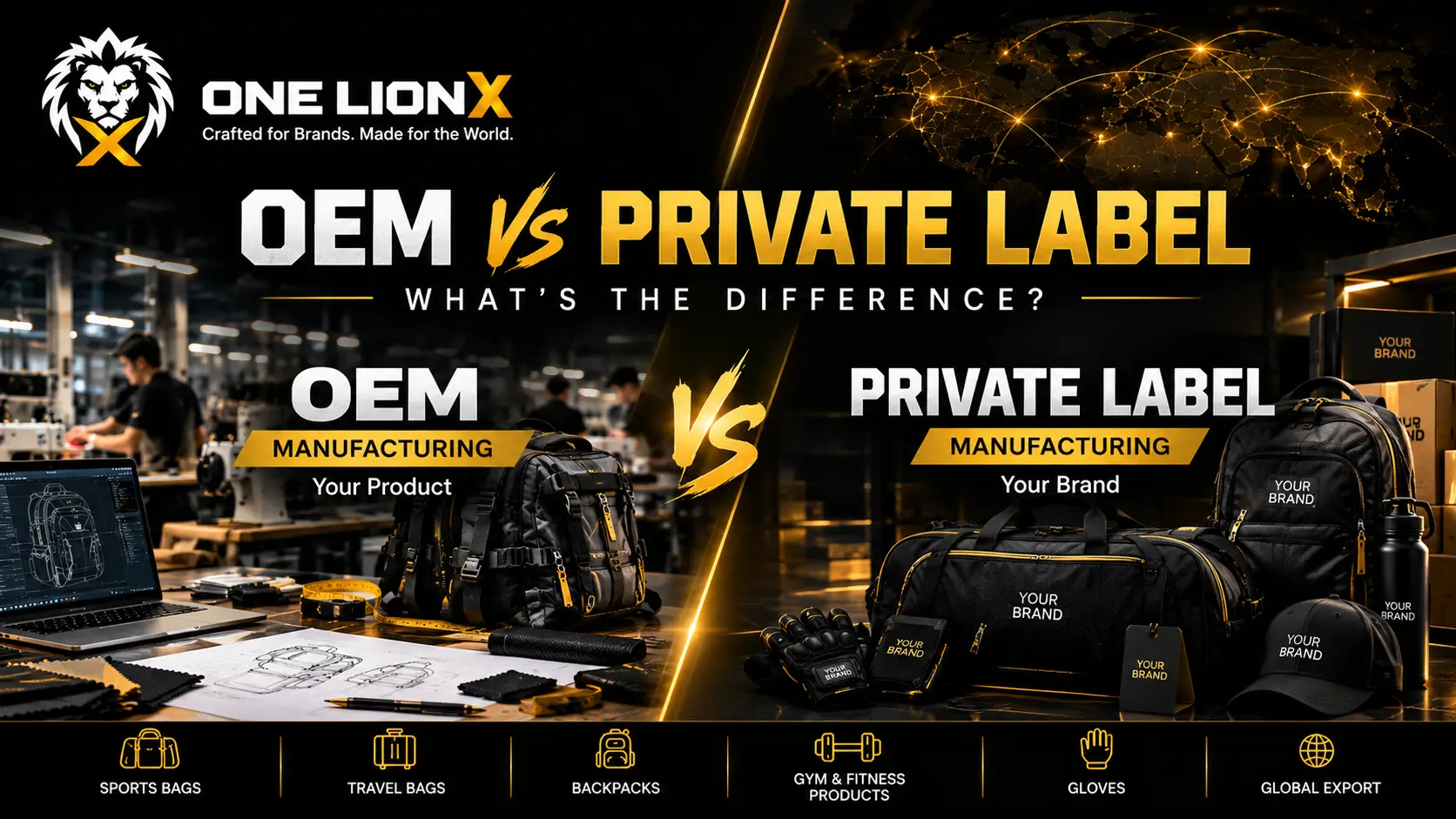
OEM vs Private Label: What’s the Difference?
When launching or expanding a product line, brands often consider OEM manufacturing and private label manufacturing.
Although the two approaches can sometimes overlap, they generally involve different levels of product development, customization, branding, and manufacturing involvement.
Understanding the difference can help brands, wholesalers, distributors, and importers choose a manufacturing approach that fits their product requirements and business model.
In this guide, we explain OEM vs private label manufacturing, how each works, and the key factors to consider when planning your next product.
What Is OEM Manufacturing?
OEM stands for Original Equipment Manufacturer.
In an OEM manufacturing arrangement, a brand typically provides or defines the product requirements that the manufacturer will produce.
These requirements may include:
- Product design
- Dimensions
- Materials
- Colors
- Construction
- Features
- Components
- Branding
- Packaging
- Technical specifications
The manufacturer then develops or produces the product according to the agreed requirements.
Example
Imagine a sports brand wants to launch a completely new sports bag.
The brand provides:
- A product drawing
- Specific dimensions
- Fabric requirements
- Compartments
- Handle design
- Branding
- Packaging requirements
The manufacturer develops the product and produces it according to those specifications.
This is an example of an OEM manufacturing approach.
What Is Private Label Manufacturing?
Private label manufacturing generally involves products that are sold under a buyer’s own brand name.
The product may come from an existing manufacturer range or may be developed and customized together with the manufacturer.
The buyer can typically customize elements such as:
- Logo
- Labels
- Packaging
- Colors
- Branding
- Product specifications
- Selected features
The finished product is then marketed and sold under the buyer’s brand.
Example
A fitness company wants to launch its own branded training gloves.
Instead of developing every aspect of the glove from the beginning, the company works with a manufacturer to select or develop a suitable product.
The manufacturer then adds:
- Company logo
- Brand labels
- Packaging
- Required colors
- Agreed specifications
The final product is sold under the fitness company’s brand.
This is an example of private label manufacturing.
OEM vs Private Label: The Main Difference
The simplest way to understand the difference is:
OEM Manufacturing
Your Product.
The product is manufactured around your defined design, specifications, or technical requirements.
Private Label Manufacturing
Your Brand.
The product is manufactured or selected for sale under your brand with agreed branding and customization.
Custom Manufacturing
Your Requirements.
The product is developed or modified around specific requirements such as materials, dimensions, construction, features, functionality, and branding.
These definitions can vary between manufacturers, so the exact scope should always be agreed before production.
OEM vs Private Label Comparison
| Factor | OEM Manufacturing | Private Label Manufacturing |
|---|---|---|
| Product development | Often highly customized | Existing or jointly developed |
| Design control | Generally higher | Depends on product |
| Product specifications | Defined by buyer | Agreed with manufacturer |
| Branding | Customized | Customized |
| Materials | Can be specified | Selected or customized |
| Product features | Can be fully customized | Depends on available options |
| Development time | May be longer | Can be shorter |
| Customization | High | Moderate to high |
| Best suited for | Unique products | Branded product lines |
The actual capabilities and process depend on the manufacturer and product category.
Which Is Better for Your Brand?
There is no single approach that works for every business.
The right model depends on what you are trying to achieve.
Choose OEM Manufacturing When:
You have:
- Your own product design
- Technical specifications
- A reference sample
- Specific materials
- Unique dimensions
- Custom features
- A detailed product concept
OEM can be suitable when the product itself needs to be developed around your requirements.
Consider Private Label When:
You want to:
- Launch a branded product line
- Use an existing or jointly developed product
- Add your own logo and labels
- Customize packaging
- Enter the market more quickly
- Build a product range under your brand
Private label can be useful when branding and market positioning are major priorities.
Can OEM and Private Label Be Combined?
Yes.
In some manufacturing projects, a brand may use elements of both approaches.
For example, a business could start with a manufacturer’s existing product and then customize:
- Materials
- Dimensions
- Colors
- Features
- Logo
- Labels
- Packaging
The final product can then be manufactured specifically for the brand.
This is why it is important to discuss the complete project requirements with the manufacturer rather than relying only on the terminology.
OEM vs Private Label for Bags
Both approaches can be used for bag manufacturing.
At One Lion X, product categories include:
Sports Bags
Custom sports bags, gym bags, team bags, training bags, and equipment bags.
Travel Bags
Travel duffel bags, weekend bags, travel backpacks, and custom travel solutions.
Backpacks
Travel backpacks, business backpacks, laptop backpacks, sports backpacks, and custom backpack solutions.
Gym & Fitness Products
Products developed around gym, training, fitness, and performance requirements.
Gloves
Fitness, training, sports, cycling, outdoor, work, and utility glove solutions.
The manufacturing approach depends on the buyer’s product requirements and desired level of customization.
What Can You Customize?
Whether you choose an OEM or private label approach, customization may include several product elements.
Materials
Different fabrics, synthetic materials, mesh, webbing, padding, lining, and other materials can be considered based on product requirements.
Dimensions
Product size, capacity, compartments, pockets, handles, straps, and other dimensions can be customized depending on the project.
Construction
Stitching, reinforcement, seams, panels, closures, handles, straps, and other structural elements can be developed around the intended use.
Branding
Branding options can include:
- Logos
- Labels
- Patches
- Printing
- Embroidery
- Embossing
- Hang tags
Packaging
Packaging can be developed around the brand, product type, presentation, labeling, and export requirements.
OEM & Private Label Manufacturing Process
A structured manufacturing process can help keep product development organized.
01 — Requirements
Define the product, specifications, target market, branding, order quantity, and other requirements.
02 — Product Review
Review designs, drawings, reference samples, or existing products.
03 — Development
Develop or customize the product according to the agreed requirements.
04 — Sampling
Create samples for evaluation and approval.
05 — Production
Begin bulk manufacturing after product approval.
06 — Quality Control
Check relevant aspects of materials, construction, functionality, branding, and finishing.
07 — Packaging
Prepare products according to agreed packaging and labeling requirements.
08 — Export
Prepare completed orders for international shipment and global supply.
Questions to Ask Your Manufacturing Partner
Before starting production, it is useful to clarify the following:
Can you develop my product from a drawing or sample?
This helps determine whether the manufacturer can support your development requirements.
Can I specify my own materials?
Ask about available materials, sourcing, testing, and customization options.
Can product dimensions be changed?
Confirm how much flexibility is available for sizes, compartments, handles, straps, and other features.
Can you add my branding?
Discuss logos, labels, patches, printing, embroidery, packaging, and other branding requirements.
Can you produce samples?
Sampling allows you to review the product before committing to bulk production.
What production quantities do you support?
Discuss expected order volumes and potential repeat production.
Can you support international export?
If you sell internationally, discuss packaging, labeling, bulk packing, and export preparation.
Why Choose a Manufacturing Partner With Both Capabilities?
For growing brands, having access to both OEM and private label manufacturing can provide flexibility.
A business may start with a simpler branded product and later move toward more customized product development.
For example:
Private Label → Product Customization → Custom Manufacturing → OEM Development
As product requirements become more specific, the manufacturing relationship can evolve accordingly.
OEM vs Private Label: Key Takeaway
The key difference is straightforward:
OEM focuses on manufacturing your defined product requirements.
Private label focuses on building a product under your brand.
If you already have a detailed product concept, design, or technical specifications, OEM manufacturing may provide the customization you need.
If you want to launch a branded product line using an existing or jointly developed product, private label manufacturing may be more suitable.
And when your requirements involve significant changes to materials, dimensions, construction, features, and functionality, custom manufacturing can provide another approach.
The most important step is to clearly communicate your requirements and agree on the scope of development and production before manufacturing begins.
How One Lion X Supports OEM & Private Label Manufacturing
One Lion X works with global brands, wholesalers, distributors, and importers seeking customized product manufacturing solutions.
Our capabilities include:
- OEM Manufacturing
- Private Label Manufacturing
- Custom Product Development
- Product Customization
- Bulk Production
- Quality Control
- Custom Packaging
- Global Export
We manufacture:
Sports Bags • Travel Bags • Backpacks • Gym & Fitness Products • Gloves
From product development and sampling to bulk production and export preparation, our manufacturing solutions are built around your product and market requirements.
Ready to Build Your Product?
Have a product design, reference sample, existing product, or simply an idea?
Share your requirements with One Lion X and let’s discuss the right manufacturing approach for your brand.
REQUEST A QUOTE →
START YOUR CUSTOM PROJECT →
Crafted for Brands. Made for the World.